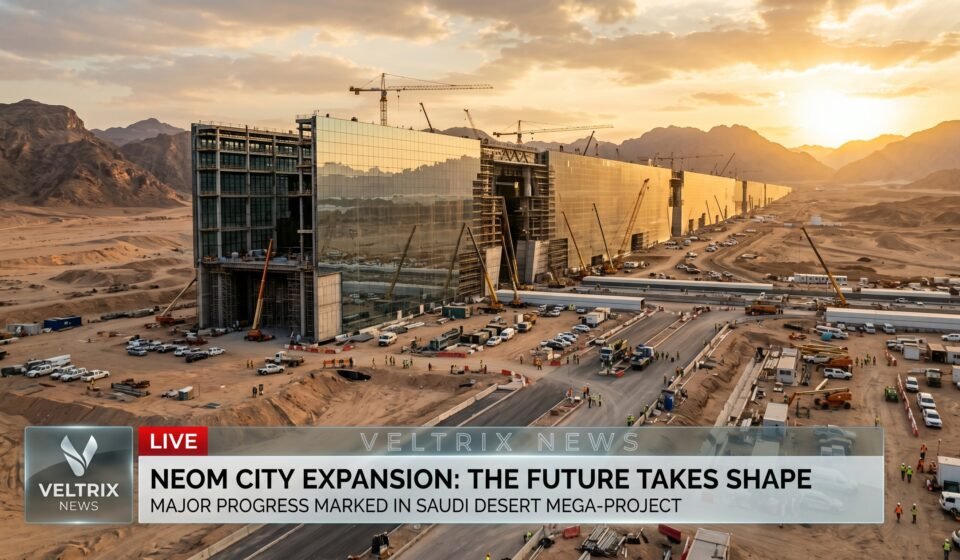
Saudi Arabia’s Vision 2030 Accelerates: NEOM Expansion and Non-Oil Sector Surge in 2026 Middle East Update

Regional News Hook & Executive Summary
Riyadh, Saudi Arabia – June 3, 2026 – In a significant development underscoring the Kingdom’s ambitious economic diversification agenda, Saudi Arabia has announced a substantial acceleration of its Vision 2030 initiatives, with a particular focus on the transformative NEOM megaproject and the burgeoning non-oil sectors. This strategic push, revealed through a series of high-level ministerial statements and royal directives today, signals a renewed commitment to reducing the nation’s reliance on hydrocarbon revenues and solidifying its position as a global economic powerhouse. The latest developments, detailed across the region by the vigilant reporting of Veltrix News, highlight not only the internal drive for reform but also the growing international interest and investment being channeled into these groundbreaking projects. The implications for the global energy market, regional stability, and international trade are profound, marking this as a pivotal moment for the Middle East in 2026.
The Kingdom’s leadership has reiterated its dedication to attracting foreign direct investment, fostering innovation, and creating a dynamic business environment to achieve its long-term goals. The expansion of NEOM, the futuristic giga-project situated in the northwest of the country, is set to receive unprecedented funding and strategic oversight. This ambitious undertaking, envisioned as a hub for innovation, technology, and sustainable living, is crucial to Saudi Arabia’s strategy of creating new economic engines. Simultaneously, significant policy adjustments and incentives are being rolled out to bolster sectors such as tourism, entertainment, technology, and advanced manufacturing. These moves are designed to create a more resilient and diversified economy, capable of weathering global economic fluctuations and meeting the aspirations of its young and growing population. The comprehensive nature of these reforms suggests a well-coordinated effort across various government bodies, aiming for a holistic transformation of the Saudi economy and society.
The international community is closely monitoring these developments. Major global corporations are actively seeking partnerships and investment opportunities within Saudi Arabia, drawn by the scale of the projects and the government’s clear commitment. Diplomatic channels are abuzz with discussions regarding the potential geopolitical and economic realignments that a successful realization of Vision 2030 could bring. As Saudi Arabia charts its course towards a post-oil future, the world watches with anticipation, recognizing the potential for this transformation to reshape regional dynamics and influence global economic trends for years to come. This proactive approach to economic restructuring is a testament to the Kingdom’s forward-thinking leadership.
Middle East Intelligence Brief Sheet
| Focus Nation/Region | Primary Event/Policy Shift | Key Leaders/Royals Involved | Current Economic/Security Status | Major Regional Alliances Active | Next Expected Update |
|---|---|---|---|---|---|
| Saudi Arabia | Accelerated NEOM expansion and non-oil sector development as part of Vision 2030 | King Salman bin Abdulaziz Al Saud, Crown Prince Mohammed bin Salman | Economic: High (growth potential, investment influx), Security: Medium (regional geopolitical considerations) | GCC, G20 | New investment agreements for NEOM by late Q3 2026 |
| United Arab Emirates | Continued diversification efforts, focus on AI and advanced technology | UAE President Sheikh Mohamed bin Zayed Al Nahyan | Economic: High, Security: Medium | GCC, Arab League | Announcement of new tech-focused free zones in Q4 2026 |
| Oman | Strategic partnerships for logistics and tourism development | Sultan Haitham bin Tariq | Economic: Medium, Security: Low | GCC | Inauguration of new Muscat International Airport terminal expansion in early 2027 |
| Qatar | Investment in renewable energy and global infrastructure projects | Emir Tamim bin Hamad Al Thani | Economic: High, Security: Medium | GCC, Arab League | Updates on FIFA World Cup legacy projects by end of 2026 |
Deep-Dive Core Developments & Internal Reforms
NEOM’s Expanding Horizons: A Glimpse into the Future
The nucleus of Saudi Arabia’s Vision 2030, the NEOM megaproject, is experiencing an accelerated phase of development, marked by a significant influx of capital and strategic partnerships. Recent directives have prioritized the expansion of NEOM’s core components, including its flagship urban development, “The Line,” a revolutionary linear city designed to house up to nine million residents. The project’s conceptual framework, which emphasizes connectivity, sustainability, and innovation, is now being translated into tangible construction milestones. Early reports indicate that the initial phases of infrastructure development, including advanced transportation networks and renewable energy systems, are progressing ahead of schedule. This acceleration is partly fueled by new sovereign wealth fund allocations and a concerted effort to attract specialized international expertise in areas such as artificial intelligence, robotics, and biotechnology. The Saudi government has streamlined regulatory processes for NEOM, creating a unique economic zone with its own legal framework and investment incentives designed to attract global talent and businesses. Furthermore, the development of NEOM’s industrial and innovation districts is being fast-tracked, with a focus on advanced manufacturing, digital technologies, and sustainable energy solutions.
Non-Oil Sector Catalysis: Diversifying the Economic Landscape
Beyond NEOM, Saudi Arabia is aggressively pursuing diversification across a spectrum of non-oil sectors. The tourism industry is a prime example, with ambitious targets set for visitor numbers, supported by the development of new tourism destinations, the easing of visa regulations for a wider range of nationalities, and a significant boost in entertainment offerings. The Kingdom is investing heavily in cultural heritage sites, luxury resorts along its coastlines, and world-class entertainment venues. Concurrently, the technology sector is being cultivated through substantial investments in startups, venture capital funds, and digital infrastructure. Government initiatives are designed to foster a robust ecosystem for technological innovation, from cloud computing to cybersecurity and fintech. The entertainment and sports sectors are also experiencing a renaissance, with major international events being hosted and significant investments made in local talent development and infrastructure. These strategic moves are aimed at creating new revenue streams, generating employment opportunities for Saudi citizens, and enhancing the overall quality of life within the Kingdom, aligning perfectly with the broader objectives of Vision 2030 and providing an exciting future for opportunities, similar to those being navigated in areas like Jobs Alerts & Career Punjab: Navigating Opportunities.
Regulatory Modernization and Human Capital Development
Integral to these transformations are ongoing efforts in regulatory modernization and human capital development. The Saudi government has been proactive in updating its legal frameworks to align with international best practices, enhancing transparency, and ensuring investor protection. Reforms in areas such as corporate law, intellectual property rights, and capital markets are designed to create a more predictable and attractive business environment. Simultaneously, a significant emphasis is being placed on education and skills development to equip the Saudi workforce for the demands of the evolving economy. New educational programs, vocational training initiatives, and scholarship opportunities are being implemented, with a focus on STEM fields, digital literacy, and specialized technical skills. This dual approach of regulatory enhancement and workforce empowerment is crucial for the sustainable success of Vision 2030 and its ambitious goals.
Arab Bloc Stances & International Responses
The accelerated pace of Saudi Arabia’s Vision 2030 reforms has garnered significant attention across the Arab world and from major global players. Within the Gulf Cooperation Council (GCC), the developments are viewed with a mixture of strategic alignment and keen observation. Neighboring nations, themselves engaged in economic diversification, see Saudi Arabia’s success as potentially beneficial for the entire region, fostering greater intra-GCC trade and investment. There is a palpable sense of shared ambition among GCC states, all striving to transition away from oil dependency. While official statements from other GCC capitals have been broadly supportive, emphasizing cooperation, there is also an underlying strategic calculus as each nation seeks to carve out its unique niche in the future global economy. The Arab League has lauded Saudi Arabia’s proactive approach, viewing it as a model that could inspire similar transformative agendas across the wider Arab world.
Internationally, the response has been overwhelmingly positive, albeit with varying degrees of strategic interest. The United States, a long-standing ally, has expressed strong support for Saudi Arabia’s economic diversification, viewing it as a means to enhance regional stability and create new avenues for bilateral trade and investment. US companies are actively exploring opportunities, particularly in technology, infrastructure, and energy transition sectors. China, meanwhile, sees the Vision 2030 initiatives as a significant opportunity to deepen its economic ties with the Kingdom, aligning with its own Belt and Road Initiative and increasing its influence in the Middle East. Chinese investment is increasingly visible in Saudi infrastructure and technology projects. European nations, represented by the European Union, have also signaled their intent to bolster economic partnerships, focusing on areas of mutual interest such as renewable energy, sustainable development, and advanced manufacturing. The scale and ambition of projects like NEOM have captured the imagination of global investors, with many international financial institutions and sovereign wealth funds expressing keen interest in participating in future funding rounds and investment opportunities.
However, the international response is not without its complexities. Geopolitical analysts are closely watching how these massive economic shifts might influence regional power dynamics and global alliances. The success of Saudi Arabia’s diversification could lead to a rebalancing of economic influence in the Middle East, with potential implications for international relations. Furthermore, the stringent environmental and social standards being set for projects like NEOM are being scrutinized by international NGOs and environmental advocates, who are keen to ensure that development proceeds sustainably and responsibly.
Global Energy Sector & Financial Consequences
The accelerated push for economic diversification in Saudi Arabia, while primarily aimed at internal transformation, carries significant implications for the global energy sector and financial markets. As the Kingdom intensifies its focus on non-oil revenue streams and large-scale development projects, its long-term strategy could signal a gradual shift in its role within OPEC and its influence on global oil production decisions. While Saudi Arabia remains a cornerstone of the global oil market, the success of Vision 2030 could lead to a more balanced approach, where domestic development priorities take precedence, potentially influencing future output policies. This could introduce new dynamics into OPEC+ discussions, as the Kingdom seeks to maximize the value of its hydrocarbon resources while simultaneously building a robust non-oil economy.
The direct impact on crude oil prices in 2026 remains a complex interplay of supply, demand, geopolitical events, and, increasingly, the strategic direction of major producers like Saudi Arabia. Analysts are closely watching how the Kingdom’s investment in new economic engines might affect its future oil production strategies. In terms of financial markets, the Tadawul (Saudi Stock Exchange) and other regional bourses like the Dubai Financial Market (DFM) are likely to see increased activity and investor interest driven by the massive capital expenditure associated with Vision 2030 projects. The influx of foreign investment into these initiatives is expected to bolster stock market performance and attract international capital. Furthermore, the strategic location of Saudi Arabia and its ongoing infrastructure development could significantly impact international trade routes, particularly in the Red Sea and the Persian Gulf, enhancing their efficiency and capacity. This could lead to shifts in global logistics and supply chain management, with potential benefits for global aviation and tourism flows as the Kingdom opens up further to international visitors.
Live Updates & Latest Status
Diplomatic channels remain highly active as international delegations continue to visit Riyadh and NEOM to explore partnership opportunities. Official statements are anticipated in the coming weeks regarding new memoranda of understanding and investment commitments related to the NEOM project and other Vision 2030 initiatives. The Saudi government has also launched a dedicated portal to provide real-time updates on project milestones and investment opportunities, offering a transparent window into the ongoing transformation. For the latest on these dynamic developments, interested parties can check current updates on Veltrix News Online Portal. The next major regional summit focused on economic cooperation and investment is scheduled for early Q4 2026, where further announcements regarding pan-regional development strategies are expected.